Serendipitous Predictions on Next-generation Learning 22/05/2024
Posted by abasiel in Uncategorized.add a comment
Some unstructured discussions can produce serendipitous results. Please see some notes below where I discussed ‘next-generation’ learning. We covered some interesting topics such as:
> Telepistemology – how we view knowledge gained via eLearning. Shift from content to process and context See https://repository.mdx.ac.uk/item/81v34 , https://repository.mdx.ac.uk/item/82qw3 , https://repository.mdx.ac.uk/item/82qwy
> B2C – ‘Train-the-Trainer’ workshop series. See https://abasiel.uk/2023/06/20/webinar-design-draft-workshop-outline/
> B2B – Work Based Learning and Accreditation of Prior Learning (APL). Linking online courses, masterclasses, training, etc. university credit towards BSc, MSc, Doctorate awards. See https://repository.mdx.ac.uk/item/84qq6
> Socratic webinar discussion circles – ‘fishbowl discourse model’ See https://abasiel.uk/elearning-r-d/
> AI in learning and assessment – https://abasiel.uk/2024/05/21/a-4-stage-ai-assisted-assessment-model/
> Gamification and Learning simulations – https://www.youtube.com/watch?v=v49lkIx_sEE
A 4-stage AI assisted assessment model 21/05/2024
Posted by abasiel in Uncategorized.Tags: assessment, education, learning, online-learning, teaching
1 comment so far
Dr Anthony ‘Skip’ Basiel | abasiel@gmail.com
This Project Proposal aims to use AI to develop an innovative assessment model by blending with learning simulations. Education Institutions in the United Kingdom (UK) use learning assurance procedures to produce evidence of a learner’s academic knowledge, capabilities or skills (Hoecht, A 2006). There are 3 general types of summative assessment. Traditional exams use a criterion-based methodology (Scarpa, R. 2011). This is often an individual written (open or closed book / on-or-offline) essay set to a sequence of questions. An external marking criteria or rubric is applied to the responses to establish a grade ranking of learning outcome (LO) mastery from distinction to merit to pass or fail (Cox, G 2015). This assessment system does not consider the learner’s prior knowledge. The initial assumption is ‘tabula rasa’, or the learner is a blank slate (DLE 2024). Rather than measuring the learners’ assessment evidence against a fixed external set of criteria, a norm-referenced model can be used (Hoko, J). Here the learner’s capabilities are ranked against the others in their assessment group. The highest marks are seen as distinction in relation to a grading curve (Aviles, C. 2001), but still the assessment rubric is an external criterion.
What assessment model can factor-in the learner’s prior and professional experiential, or tacit, knowledge? An ipsative assessment design uses a pre-test comparison to the final evaluation (Hughes, G. 2011). In this way we set learning benchmarks. First, we establish the baseline of the learner’s knowledge and skills. Next, stakeholders progress through the learning event’s curriculum. A summative assessment concludes the sequence. Marking is done by measuring the difference between the pre-test to the endpoint.
These summative assessment models can also use a web 2.0 learner-generated content methodology (Basiel A. & Coyne P.2009). A learner-centred pedagogy uses a bottom-up curriculum/assessment design demonstrated in two interventions:
Self-assessment – Pre-set learning outcomes are mapped to the evidence in the deliverables of the assessment media. For example, in a written exam the LO is linked to the page providing evidence of mastery. In a dynamic role-play (learning simulation) assessment, the link could be in the transcript or video of the skill performed.
Peer-review – A study partner/group provides the learner with peer feedback from the stakeholders’ perspective of the LOs. A read-aloud protocol (Gibson 2008) can be used to hear grammar mistakes or unclear narration.
This project explores how AI can be used in combination with learning simulations as a process supported by the content and/or skills required to be successful (Linser, R. & Ip, A. 2002). Shaharuddin et al. (2012) recognises the importance of underpinning the learning simulation choreography with a social constructivists’ foundation. The stakeholders in the simulated learning event make meaning as they address the issue or solve the problem of the scenario. The learner can be an individual interacting with an avatar or other humans via a webinar platform. The simulation facilitator(s) provide and induction and context to the scenario before the role-play is initiated.
This proposed blended learning model uses a convergence of AI with interactive webinar design. It is a trans-disciplinary approach that aims to promote the development of procedural knowledge, creativity and innovation as well (if needed) as the demonstration of specific skills. For example, if the simulation was to access the SGS counselling courses (2024) a scenario to validate the required counselling practice could be demonstrated through the virtual role-play.
Where does the AI component fit into the framework design? There are 3 stages in our AI Blended Simulation Assessment model:
- Pre-test
- Virtual Simulation
- Debriefing
Stage 1:
A generative AI tool such as Teachermatic (2024) can provide a pre-test multiple choice quiz (MCQ) with correct responses and links to core reading references. The prompt may include the knowledge domain, academic/professional level, course learning outcomes/competencies to acquire, links to government standards (e.g. data protection, GDPR 2024), ethical guidelines (e.g. BERA 2024), etc. The tutor can then review and refine the pre-assessment tool to help establish the learner’s starting knowledge. A variation of this stage can be to get the students to contribute to the MCQ pool of questions, answers and reference sources. This is another example of a learner-generated (Web 2.0) assessment approach.
Stage 2: The production of the learning simulation is linked to the academic partners for this pilot case study. An output of the study will be establishing the appropriate blend of the use of AI, video and human role-play that will be used with each tutor and their subject specific requirements. Using the module learning outcomes as a guide a script can be played out by using the human participants and/or digital twins. An example of how AI and digital twins can be uses is seen through a blended workshop conducted at Bournemouth University (2024) and presented in a conference at the University of London (2024) (Basiel 2024). Recordings of the event provides evidence that can validate the module learning outcomes. Variations of digital simulation environments will be explored. Klaxoon (2024) is a platform we can use who have partnered with us in the past.
Stage 3: Arguably the most important part of the learning situation is debriefing at the end (Fanning 2007). One or two Facilitators (on-or-offline) ask open-ended questions to the key simulation actors (Cheng et al. 2015). The discussion identifies general reflection issues such as what went well, where could you improve and what would you do differently? Subject specific questions linked to the learning outcomes can be added to the debriefing script. One variation to be explored is the use of digital twins as one of the debriefing Facilitators for non-empathetic questions. The virtual debriefing model can use a Socratic discussion circle (Howarth, M.S. and Basiel A. 2022). Key actors sit in a central circle with the observers on the outer circle. Responses start with the inner circle actors with the outer circle learners joining with their perspectives. In person debriefing can use a 360* augmented reality camera to record the event allowing the viewer to click on the video to see around the room from different angles. See an example at https://abasiel.uk/2024/03/15/360-immersive-blended-webinar-ai-turing-test/ .
SMART (specific, measurable, achievable, relevant and time-bound) Project Objectives:
This proposal aims to address the BERA goals to research and develop the innovative use of AI in a Further Education context. The SMART objectives are:
Establish a sound project management strategy to promote communication between the study partner organisations and the stakeholders.
Identify appropriate technologies to support the case study for the AI Blended Simulation Assessment model.
Apply underpinning pedagogic designs to research and develop the case study stages (e.g. pre-test, simulation, debriefing).
Comply with BERA ethics and GDPR policy to collect and analyse data to attempt to validate project conclusions.
Build a virtual learning community to disseminate project findings.
Evaluation
The project designs will be validated by data collected in a pre/post event survey and webinar focus groups. We establish what the stakeholders’ pre-expectations are going into the learning event which are matched against the summative assessment results.
References
Aviles, C. B. (2001). Grading with norm-referenced or criterion-referenced measurements: To curve or not to curve, that is the question. Social Work Education, 20(5), 603–608. https://doi.org/10.1080/02615470120072869
Basiel A. Coyne P. (2010), ‘Exploring a Professional Social Network System to Support Learning in the Workplace Social’ Web Evolution: Integrating Semantic Applications and Web 2.0 Technologies DOI: 10.4018/978-1-60566-272-5.ch001
Basiel, A. (2024) https://abasiel.uk/2024/04/26/u-of-london-ride-conference-24/
BERA (2024) https://www.bera.ac.uk/publication/ethical-guidelines-for-educational-research-2018
Cheng, A, Palaganas, J. Walter, Rudolph, J., Robinson, T., Grant, V. (2015), ‘Co-debriefing for Simulation-based Education, A Primer for Facilitators’, Simulation in Healthcare: The Journal of the Society for Simulation in Healthcare 10(2):p 69-75, April 2015. | DOI: 10.1097/SIH.0000000000000077
Cox, G.; Morrison, J.; Brathwaite, B. (2015). The Rubric: An Assessment Tool to Guide Students and Markers. En 1ST INTERNATIONAL CONFERENCE ON HIGHER EDUCATION ADVANCES (HEAD’ 15). Editorial Universitat Politècnica de València. 26-32. https://doi.org/10.4995/HEAd15.2015.414
Discourses on Learning in Education (DLE 2024) https://learningdiscourses.com/discourse/tabula-rasa/
Fanning, R. M.; Gaba, D. M.(2007), The Role of Debriefing in Simulation-Based Learning The Journal of the Society for Simulation in Healthcare 2(2):p 115-125, Summer 2007. | DOI: 10.1097/SIH.0b013e3180315539
GDPR (2024) https://gdpr-info.eu/
Gibson S. (2008), Reading aloud: a useful learning tool?, ELT Journal, Volume 62, Issue 1, January 2008, Pages 29–36, https://doi.org/10.1093/elt/ccm075
Hoecht, A. Quality Assurance in UK Higher Education: Issues of Trust, Control, Professional Autonomy and Accountability. High Educ 51, 541–563 (2006). https://doi.org/10.1007/s10734-004-2533-2
Hoko, J. Aaron. “Evaluating Instructional Effectiveness: Norm-Referenced and Criterion-Referenced Tests.” Educational Technology, vol. 26, no. 10, 1986, pp. 44–47. JSTOR, http://www.jstor.org/stable/44424737. Accessed 28 Apr. 2024.
Howarth, M.S., Basiel, A. (2022). Production of the 70:20:10 Webinar. In: MacCallum, K., Parsons, D. (eds) Industry Practices, Processes and Techniques Adopted in Education. Springer, Singapore. https://doi.org/10.1007/978-981-19-3517-6_13
Hughes, G. (2011) ‘Towards a personal best: a case for introducing ipsative assessment in higher education’, Studies in Higher Education, 36(3), pp. 353–367. doi: 10.1080/03075079.2010.486859.
Klaxoon (2024) – https://klaxoon.com
Linser, R. & Ip, A. (2002). Beyond the Current E-Learning paradigm: Applications of Role Play Simulations (RPS) – case studies. In M. Driscoll & T. Reeves (Eds.), Proceedings of E-Learn 2002–World Conference on E-Learning in Corporate, Government, Healthcare, and Higher Education (pp. 606-611). Montreal, Canada: Association for the Advancement of Computing in Education (AACE). Retrieved April 29, 2024 from https://www.learntechlib.org/primary/p/15277/.
Scarpa, Raymond DNP, AOCN; Connelly, Patricia E. PhD, CCC-A, ABA. Innovations in Performance Assessment: A Criterion Based Performance Assessment for Advanced Practice Nurses Using a Synergistic Theoretical Nursing Framework. Nursing Administration Quarterly 35(2):p 164-173, April 2011. | DOI: 10.1097/NAQ.0b013e31820fface
SGS (2024) Counselling Courses https://www.sgscol.ac.uk/study/counselling
Shaharuddin Md. Salleh, Zaidatun Tasir, Nurbiha A. Shukor (2012), Web-Based Simulation Learning Framework to Enhance Students’ Critical Thinking Skills,
Procedia – Social and Behavioral Sciences, Volume 64, 2012, Pages 372-381,ISSN 1877-0428,https://doi.org/10.1016/j.sbspro.2012.11.044.
(https://www.sciencedirect.com/science/article/pii/S1877042812050215)
Teachermatic (2024) https://teachermatic.com/
BERA Research Grant 06/05/2024
Posted by abasiel in Uncategorized.add a comment

I am collaborating with https://www.sgscol.ac.uk/ and https://teachermatic.com/ and https://klaxoon.com/ and Dr Mike Howarth https://www.mhmvr.co.uk/ on putting together a Curriculum Innovation Grant https://www.bera.ac.uk/award/bcf-curriculum-investigation-grant.
We are exploring a blend of using AI to develop an innovative new assessment model. Using an Ipsative assessment design (pre-test and post test) we first establish the learner’s prior knowledge. A web 2.0 or learner-generated MCQ quiz is done along with an AI generator. This sets the baseline of the stakeholder’s academic and tacit (hands-on) knowledge. Next, we use a scenario-based or role-play lesson to have the learners apply their knowledge to a real-world context. This online learning simulation is based on the module learning objectives. The final, perhaps most important, stage is the simulation debriefing. Here the simulation Facilitators guide the key actors through the lessons learnt using a series of factual and empathetic questions. Another innovation is the use of a digital twin as a facilitator. The AI generated Facilitator asks the generic questions leaving the more sensitive issues to the human Facilitator. The session is recorded with the students in a physical room sitting in a Socratic discussion circle. Additional virtual learners participate via web video conferencing. The circle discussion is recorded with an augmented reality 360* camera for an immersive experience review. This BERA proposal aims to test through online survey and interviews the impact on the confidence level of the learners using this learning and assessment innovation. If you are interested – please email Dr Anthony ‘Skip’ Basiel abasiel@gmail.com
Research & Academic Consultancy 27/04/2024
Posted by abasiel in Uncategorized.add a comment

I am happy to announce that I have been selected again by IVY EXEC Market Research Company to be a professional Expert Consultant of Information Technology.
I have also provided consultancy in learning technology and Higher Education Learning Assurance in the past for organisations such as:
> Klaxoon Education Leader – I am collaborating with Klaxoon.com on education projects and international conferences
> Adobe International Education Leaders Program for web video conferencing,
> NIIT, India to develop an undergraduate course in graphic design
> OSOSIM: A Cambridge, UK Learning Simulation Company. I facilitated several business simulations for Senior Managers in a company in Saudi Arabia.
> Manchester Metropolitan University: External Examiner to validate the MBA Programme with the IPMI Business School, Jakarta- Indonesia
Please see other examples of my professional consultancy at: https://abasiel.uk/psn/
I can be contacted by email: abasiel@gmail.com
U of London – RIDE Conference ’24 26/04/2024
Posted by abasiel in Uncategorized.1 comment so far
Below are the resources that correspond with the Conference paper for the University of London’s RIDE conference. See:
Appendix A: Video link. Conference presentation
Appendix B: The full presentation video script
Appendix C: PowerPoint Presentation Slides / PDF of PowerPoint presentation slides / notes of the slides
Appendix D: Transcript of the discussion
This is a video https://youtu.be/SSooJgHOK_k?si=zVKAC5dAFk-1hxwi of my presentation for the University of London RIDE Conference with Dr Mike Howarth in April 2024. The draft paper can be seen at https://tinyurl.com/UofL-RIDE2024.
Here is a PDF of the slides: https://drive.google.com/file/d/1-SxkXPsm_oOcGDJB9TKXegPbQru11UaT/view?usp=sharing
The Notes for the slides (transcript) can be seen here: https://drive.google.com/file/d/1HZnoKs7EqLBU_1XssfL24Qvm3rKRVsXs/view?usp=sharing
Full draft paper can be seen at https://docs.google.com/document/d/1uTYBWoN3KsxN-m7s_xzjKhJWeNVzDhC-/edit?usp=sharing&ouid=115658292435481901964&rtpof=true&sd=true
Innovation Management – Guest Speaker Webinar 12/04/2024
Posted by abasiel in Uncategorized.add a comment
I want to thank Larna Pantrey-Mayer from actionforchildren.org.uk for doing a brilliant webinar on her role as Innovation Manager for the charity. Please contact me for the weblinks to my private access videos.
Here are the PowerPoint slides for the presentation. Click here to download.
If you wish to share this resource, please email Dr Anthony ‘Skip’ Basiel abasiel@gmail.com

Computing UX Toolkit (TM) 09/04/2024
Posted by abasiel in Uncategorized.add a comment
If you want an overview of how to identify the User Experience (UX) pain points (digital system problems) and develop a prototype (solution) You can watch our two videos below, then download the UX Toolkit (Word document checklist). Please do email Dr Anthony ‘Skip’ Basiel at abasiel@gmail.com to collaborate.
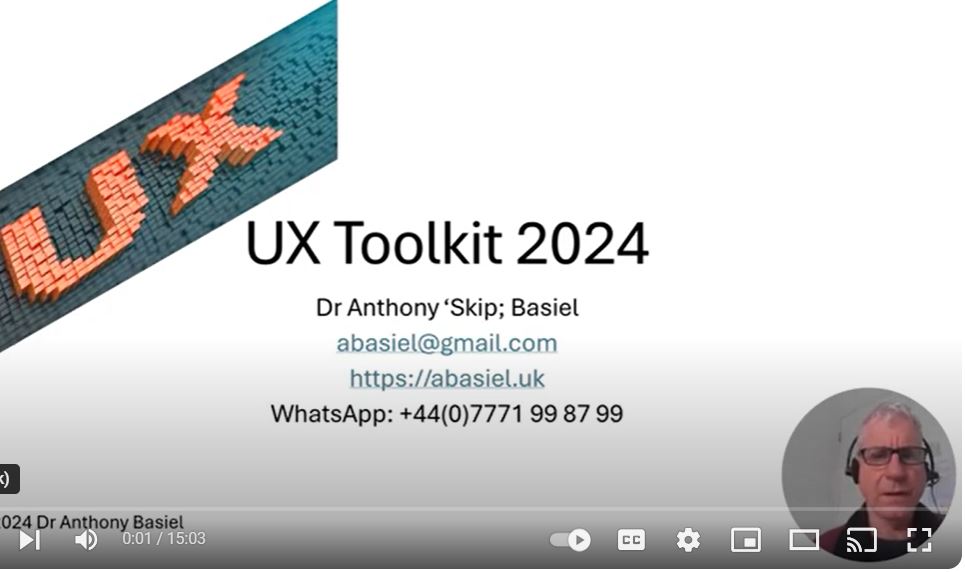
A) Video 1 of 2: [ 15 minutes ] Provides the first half UX strategy to find out the challenges (or pain points) for a digital system (e.g. website).
B) Download the UX Toolkit Word document to apply the steps from the video. Use a new template for each pain point you analyse. Click https://tinyurl.com/UXtoolkit2024 to add your notes.
C) Video 2 of 2: [ 15 minutes ] See how you can develop your UX prototype solutions in the second video below.
Download the Zip file with: a) PowerPoint slide deck (to simulate the website navigation) b) PDF of slides c) Word Template Toolkit checklist. [ Click here to download ]
International Conference Keynote 29/03/2024
Posted by abasiel in Uncategorized.add a comment
I presented our research in immersive webinar design at the Trends and Training Conference. Here is my certificate below. Please do contact me if you are interested in collaboration.
– Anthony ‘Skip’ Basiel abasiel@gmailcom

International Webinar Conference 25 March ’24 22/03/2024
Posted by abasiel in Uncategorized.add a comment

Trend and Training are hosting an international webinar. See https://university-conf.com/Speakers_Digitalization_of_the_%D0%B5ducational_process/
I will be a key speaker looking at: Socratic Discussion Circles: Engagement through a Blended Webinar Design
See details at https://abasiel.uk/augmentedreality/
We invite you to contribute with your definition of knowledge!
Please email Dr Anthony ‘Skip’ Basiel at abasiel@gmail.com if you would like to collaborate.
360* Immersive Blended Webinar: AI Turing Test 15/03/2024
Posted by abasiel in Uncategorized.1 comment so far
This is an Insta 360* VR camera recording of the Bournemouth University Conference on 29 Feb. 2024. As a pilot study we are working on improving our model. For example, in some sections of the presentation the sound quality can be improved. We will be adding captions and a Teams recording soon. Please do email Dr Anthony ‘Skip’ Basiel at abasiel@gmail.com with any questions or opportunities to collaborate in research.
Yours, Anthony
~~~~~~~~~~~~~~~~~~~~~~~~~~~
