IEMA response 15/11/2025
Posted by abasiel in Uncategorized.Tags: education, higher-education, learning, teaching, writing
add a comment
| Thanks to (Prof Dr) Mike Moulder for the response below about my recent IEMA posting. I am happy to discuss any research project collaboration by email abasiel@gmail.com Yours, Anthony ~~~~~~~~~~~~~~~~~~~~~~~~~~~~~~~~~~~~~~/ Dr Moulder says: ‘I attend the IEMA sessions and find them very informative. I found your article (University of the Future: What learning designs and systems can support next-generation higher education stakeholders? ) very stimulating. I agree with many of your views and give below my thoughts/ some practical examples of why I agree with your approach. My experience is mainly in the real world as a CFO in multinationals, SMEs and nfp e.g. European Commission plus part time Professor fitting into this career, see my linked in page https://www.linkedin.com/in/mike-moulder-56b84810/?originalSubdomain=uk. I also am now interested in startups and SMEs and deliver workshops e.g. Skills4Startups® Global Business Roadshows (next is in London on 17th November 2025) Since 2010, I have taught in France and the Netherlands and on line to other countries, using workshops where I am a guide on the side rather then a sage on the stage. I say to students that my workshops are not a tick in the degree box but are designed to help them in their careers. I use a workshop approach and keep my applied finance/business strategy to solve real world issues. BUT also, I do not deliver ‘toolkits’ but aim that students adopt a logical, well researched approach to unknown challenges (we have many in the real world!), i.e. as Dawson (2019) suggests: “expert thinking,” meaning “the ability to solve new problems that cannot be solved by rules,” I also think that guidance on research is important – the ability to target relevant information from the tsunami available within a short timeframe, that is what is needed in the real world. My observation is that promotion in many universities hinges on having publications in moribund academic journals (three stars preferred), which from memory Harvard stated as having a readership often of <20. This is not the type of real world research that I am talking about…. I specialise in sharing knowledge inter alia on finance for normal (not financial) people, Applied Finance, Strategic/Business Planning with a financial model, (I have developed a generic financial model to integrate in any business plan). I have used my real world experience to create short case studies that cover most of the applied finance syllabus. I only use workshops as a medium, not lectures: Confucius and later Dale 1954 etc. show that lectures have a poor absorption rate (15%) and retention, just of the title of the lecture, is lost after a few weeks. Workshops, on the other hand, can have absorption rates of 60%+ and long retention times. How? In teams of two, students create a Strategic Plan and financial model from an idea which they have chosen. In a ‘cafetaria’ layout, in groups of four they assign their management roles (chair, scribe researcher etc changed each session) to devise approaches to the real world challenges which I have set them via the case studies. My approach encourages students to work as teams, another real world requirement…getting on with colleagues. When I deliver on line, students are also teamed in groups of four, assigned with roles. I think it is a logical step to go from a cafeteria style workshop to an on line delivery, or working in small groups in remote locations. Issues? I think that the first one is cost. I cannot deliver a workshop to >28 participants, which could be twice the cost of a lecture to 60 students. Cafeteria layouts are also expensive. Second, reluctantly I think that many Professors/Lecturers prefer to be a sage on the stage, they want to be centre stage, and would find it frustrating to have students actively involved in the learning process. I call my students ‘participants’ to emphasise that they are actively involved and to remind me that they pay my salary. I feel that today ‘student’ has a rather negative connotation. Thirdly, unlike in France or Germany for example, Professors/Lecturers often see their career path as being solely within the university. Frankly, this ridiculous. Part of the experience of being a guide on the side is that you have real world experience. I am often in the UK, happy to have a coffee with you, if timetables permit Best regards, (Prof Dr) Mike Moulder’ ~~~~~/ Looking forward to hearing from you. – Anthony |
4th IEMA Global Event 30/10/2025
Posted by abasiel in Uncategorized.Tags: education, informal-learning, teaching, technology, webinar
1 comment so far

“Global Education Forum 2025: From Tradition to Transformation – Reimagining Relevance, Value, and Skills to Build Adaptive, Purpose-Driven Education Systems that Truly Empower the Future”
Event Concept Note: https://iema.org.uk/IEMA_Event_4_GLOBAL_EDUCATION_FORUM_Concept_Note_30-10-2025.pdf
As a member of the Webinar Keynote Speaker’s Expert Panel I was asked about government or organisational policy with respect to the university of the future.
I will add a weblink to the recording of the session for my full response, but a summary is below:
- The University of the Future will see a shift from the current formal instructional model to embrace informal learning opportunities. My book chapter in the ACPI publication, ‘The University of the Future’ is entitled:
‘What learning designs and systems
can support next-generation higher education stakeholders?‘
You can download the full draft at: https://tinyurl.com/FutureUniversityDesign
or see the video presentation at https://youtube.com/watch?v=poOKnkIPNH8&feature=shared - Government policy and organisational procedures will need to shift from the current top-down model (e.g. Management to Learner) to a bottom-up (Learner-informed curriculum development approach) or Web 2.0 structure.
- This paradigm shift in higher education will recognise the value of informal learning as identified by Lombardo, et al. (1996) with the 70:20:10 Learning Design:
70% challenging (informal) assignments
20% developmental relationships
10% formal learning and development training - The 70:20:10 Webinar design ( See https://abasiel.uk/2020/05/24/702010-webinar-design/ ) is my adaptation of informal learning to an interactive immersive web video conference. The figure below highlights the key elements:

This diagram shows the 3 stages of the 70% (Informal), 20% (Social) and 10% (formal training) being linked to examples of an instructional model. Training may be a ‘talking head’ video lecture. A breakout room discussion can be seen as social learning, while informal learning can happen in an open-ended role-play or online simulation where there is no single ‘correct’ solution to a problem. In each learning design there is a mix of theory related to the topic and how the principles are applied to form a conclusion. This is known as ‘Praxis’ (See https://abasiel.uk/?s=Praxis&searchbutton=go%21 ).
Guest Speakers
One example of informal learning in higher education is seen with the use of guest speakers from industry. There is no set curriculum or learning outcomes to be tested. Rather the ‘Industry Experts’ share real-life experiences from work projects to state lessons learnt or ‘tips to success’. I have successfully hosted monthly podcasts in the past getting positive feedback from stakeholders. You can see a ‘Guest Speaker Proposal’ document at https://tinyurl.com/InformalGuestSpeaker. A sample of my monthly webinar informal interviews with guest speakers can be seen at: https://youtube.com/watch?v=YOT_piG54as&feature=shared for the Learning Zone Talks series.
Please do email abasiel@gmail.com if you are interested in exploring these topics in more detail or if you would like to discuss hosting a webinar workshop for your organisation.
Yours, Dr Anthony Basiel
SchoRes ICSSH 2025 21/04/2025
Posted by abasiel in Uncategorized.Tags: AI, artificial-intelligence, education, teaching, technology
1 comment so far

SchoRes International Conference on Social Sciences & Humanities
I have been asked to be keynote speaker at this conference. See https://www.schores.org/conferences_details.php?acid=124
Here is the abstract and conclusion for the paper we are submitting below. Please email abasiel@gmail.com if you would like the full draft paper. This is a sample AI video I made to demonstrate how we can use AI to make a learning simulation:
Abstract
This paper explores the theory and practice of using artificial intelligence (AI) in curriculum and assessment design. The objectives are to apply AI in four stages. First, using AI in a multiple-choice question student-generated pre-test. This helps establish prior or tacit knowledge of the learners and stakeholders. Second, using AI in conjunction with blended learning role-plays or simulations. The third stage uses AI to construct and evaluate a post-simulation debriefing. Finally, in assessment stage four, AI is used to map the learning objectives to the evidence in the video recording transcripts. A case study methodology gathers evidence through surveys, interviews, video recorded observations and AI analysis of transcript text. The study concludes that AI can be integrated into the various stages of curriculum and assessment design in the role of a ‘thought partner’ as well as content producer. In these early days of applying AI to teaching, learning pedagogy and assessment an evidence-based approach to this innovative convergence of technology is recommended.
Keywords: artificial intelligence, assessment, curriculum, debriefing, pre-test, role-play, simulation, transcript evaluation.
- Conclusion
The objectives of this paper are to apply AI in four stages of the curriculum and assessment of learning simulation designs. The first stage used AI in a multiple-choice question student-generated pre-test. Learners answered questions and critically reviewed topics. AI was demonstrated in conjunction with blended learning role-plays or simulations by producing possible scenario descriptions and/or scripts. AI was used to construct and evaluate a post-simulation debriefing script in the next stage of the model learning objectives were linked to key words as evidence to support its use in assessment.
Limitations
The various pilot case studies presented in this paper were conducted with small sample size groups. Further case studies using the 4-stage AI learning simulations model are needed to gather more evidence from cross-disciplinary use.
Recommendations
Each stage of the application of AI to the curriculum and assessment models presented in this paper can be applied to the context of the reader through these recommendations:
- As the pre-test question pool grows, a review of the quality of the MCQs can filter out weaker samples.
- Simulations and role plays can be synthesized with traditional instructional materials to provide learners’ a safe setting to develop knowledge, skills and confidence.
- AI has the potential to support debriefing and reflection on learning through more applications of transcript analysis.
The authors encourage readers to contact them for collaboration opportunities to further research and develop the learning models and technologies introduced in this paper.
British Council STEM Training Proposal 07/01/2025
Posted by abasiel in Uncategorized.Tags: education, higher-education, learning, news, teaching
2 comments
This is a draft proposal to the British Council to host a STEM Training Event for international delegates for a 2-month period. The first week would be held in the UK. The last part held in the partner country.
I am happy to open a dialogue about collaboration. Please email Dr Anthony Basiel at abasiel@gmail.com subject: British Council or WhatsApp +44(0)7771998799.
The British Council and the Higher Education Commission would like to invite proposals from organisation/institutes and Universities from the United Kingdom/consortium partners including other international organizations/institutes in the higher education sector, which have relevant expertise and partnerships to work with UK (as lead partner) and Pakistan institutes on delivering STEM Faculty UK training and exposure visits.
Please use the form below to submit your proposal.
The project aims to strengthen and develop human resource capital through improved quality of higher education and skills development in Pakistan with a particular focus on training the STEM faculty across Higher Education Institutes in Pakistan.
The proposal should address the Applicant Guideline document being shared separately.
| Name of organisation (Lead Partner) | Solent University, United Kingdom. | |
| Address of organisation | E Park Terrace, Southampton SO14 0YN | |
| Contact information | Name, Title | Dr Anthony ‘Skip’ Basiel |
| Telephone | +44 7771 998799 | |
| abasiel@gmail.com; abasiel@bournemouth.ac.uk | ||
| Website/Facebook | https://abasiel.uk; | |
| Name of organisation (Co-Partner) | ||
| Address of organisation | ||
| Contact information | Name, Title | |
| Telephone | ||
| Website/Facebook | ||
| Total Budget Requested (in GBP/PKR) | £181,100 / | |
Detailed Project Description
Project Objective [166/500 words ]
STEM Faculty UK training:
This proposal aims to enhance teaching and assessment practices through conceptual understanding and exposure to new methodologies and high-impact pedagogies. This results in suitable approaches in interactive teaching STEM disciplines in Pakistan.
This project proposal will enable better student engagement through the use of:
- blended learning technologies such as learning simulations (blended role-play scenarios),
- artificial intelligence (AI) generators (e.g. https://teachermatic.com/),
- visual collaboration platform (e.g. https://klaxoon.com/ )
- augmented reality (e.g. 360* immersive video)
to develop and implement a blended learning curriculum and AI assisted assessment STEM training model.
Exposure visit for Pakistan:
The aim of the visit to the UK host organisation is to provide the Pakistan delegates with a face-to-face training experience. Through this training the STEM academics will have first-hand experience using a range of learning technologies through several innovative instructional designs.
Additionally, the exposure visit aims to meet the British Council’s mission statements to engender trust by building connections and creating understanding between the project partners.
Wider stakeholder analysis and consultation [304/500 words ]
The key stakeholders of our project are British Council Pakistan, Higher Education Commission Pakistan, Solent University UK, University of Peshawar Pakistan, students from Public and Private Universities of Pakistan, and STEM faculty members of Public and Private Universities of Pakistan.
We will engage with the project stakeholders on a weekly basis using Microsoft Teams, cloud storage of resources protected within the protection of the university firewall.
The challenge is to conduct the STEM training while working within the organisations’ ethical guidelines[1] and the data protection act[2] as well as GDPR[3].
Several stakeholder groups have been consulted in the design of this project. The host organisation, Solent University, has worked with Dr Anthony Basiel, Marc Molinari, Deputy Head for Research & Knowledge Exchange and Education and members of the Research Team.
In Pakistan Dr. Amjad Reba, Director CHRCD with the University of Peshawar has worked with Dr Seemab Ishaq, Research Assistant, Agha Khan University in consultation with the local British Council representative to organise regional STEM organisations to participate in the training.
Partner organisations that have also contributed to this proposal include:
- Teachermatic – AI generators for education: Esam Baboukhan, Director of Transform Education LTD
- Klaxoon – visual collaboration platform – Sam Cliff, Head of International Outbound.
The project partners and stakeholders have been engaged by using an agile project management approach through the use of a blend of communication and collaboration software and platforms:
- Microsoft Office 365 – platform, email, Teams, SharePoint, etc.
- Google Platform – email, cloud drive, web video meeting, etc.
- Klaxoon – mind maps, brainstorming, etc.
These partners have been active with Dr Anthony Basiel over the past few years on a variety of education research and development projects such as 360* augmented reality international conference keynote interactive presentations, webinar workshops on AI, international publications, etc.
Project Outputs [ 497/500]
The project’s proposed outputs are aligned with the British Council’s (BC) mission statement[4]:
- Create understanding between the people of the UK and other countries:
This will be achieved through the identification and implementation of suitable innovative blended approaches in teaching STEM disciplines. For example, the AI Learning Simulation Model outlined below. - Make a positive contribution to the UK and the countries they work with:
The two-way contribution of this project comes from the collaboration of the stakeholders in sharing and evaluating the use of learning technologies to support blended STEM teaching. - Change lives by creating opportunities, building connections, and engendering trust:
This BC project proposal is a follow-up to previous collaborations between the UK and Pakistan universities. Dr Basiel was a keynote speaker at an international conference hosted by the University of Peshawar. This was followed up by further research proposals and academic publications. This professional network has contributed to the success of stakeholder’s PhDs and career progression. - The project aims to enhance teaching and assessment practices through conceptual understanding, and exposure to new methodologies and high-impact pedagogies:
Through the training provided in this project using a variety of blended learning solutions, Pakistan Tutors can enable better student engagement. research knowledge and skills across the curriculum.
Artificial Intelligence (AI) Learning Simulation Model
This Project proposes to use AI to develop a curriculum assessment model. We explore ways to use AI integrated in a learning simulation. The aim is to inform the impact of AI on the confidence level of students and satisfaction of the Tutors in their learning and assessment process. Assessment events are recorded and auto-transcribed during a 4-stage process:
Stage 1 Pre-test: First we establish the learner’s prior knowledge. Students complete a quiz that sets the baseline of the academic and tacit (hands-on) knowledge.
Stage 2 Simulation: A real-world scenario or role-play simulation based on the module learning objectives is used to test the application of their knowledge and skills.
Stage 3 Debriefing: After the role-play simulation a pair of Facilitators moderate a discussion group circle.
Stage 4 Evaluation. The learning outcome are validated. A mapping of the simulation transcript to the learning outcomes’ provides evidence to determine the level of attainment.
Our project challenges current learning and assessment methods in education and the application of AI. Institutions in the United Kingdom (UK) use learning assurance procedures to produce evidence of a learner’s academic knowledge, capabilities or skills (Hoecht, A 2006). Our learning model can factor-in the learner’s prior and professional experiential, or tacit, knowledge. This model uses a pre-test comparison to the final evaluation known as an ipsative assessment design (Hughes 2011). First, a baseline of the learner’s knowledge and skills is set. Next, stakeholders progress through the curriculum. A summative assessment then measures the difference between the pre-test to the endpoint.
Our proposed learning and assessment model is a trans-disciplinary approach that aims to promote the development of procedural knowledge, creativity and the demonstration of specific skills.
Project Activities [404/500]
Each output described is linked to these specific activities:
- Create understanding between the people of the UK and other countries:
The activities supporting this output are done in two stages. First, a set of blended learning ‘ice breakers’ help the stakeholders to form a common language. These interactive tasks build a bond between the learners to promote peer-support. The relationships made in the project will be sustained when the learners return to their home institutions. Second, a pre-test is used to establish the prior knowledge of the trainees. A Web 2.0 learner-generated approach is used to create the online multiple choice question (MCQ) quiz. Students are given instruction on how to write the questions, provide the answers and identify the correct solutions. References are given to validate the correct choice. - Make a positive contribution to the UK and the countries they work with:
This applied learning model is supported by the simulation learning activities. After induction sessions provide the foundation of procedural knowledge to stakeholders, online learning simulations put the information into practice. Contributions to both the UK and Pakistan organisations come from the scenario debriefing reflections and analysis. - Change lives by creating opportunities, building connections, and engendering trust:
The training sessions use an interactive blended learning instructional design. The ‘study-partner/group’ approach applies a social learning pedagogy. Each session has activities for the stakeholders to share perspectives, professional tacit knowledge and build relationships. - The project aims to enhance teaching and assessment practices through conceptual understanding, and exposure to new methodologies and high-impact pedagogies:
The activities associated with this output are linked to the learning technologies used. For example, learning simulations (blended role-play scenarios) will involve using AI to help with script creation and video recording for transcript analysis. Artificial intelligence (AI) generators (e.g. https://teachermatic.com/) will be used by stakeholders to save time with lesson planning.Augmented reality (e.g. 360* immersive video) records the simulation debriefing sessions to allow self-assessment by reviewing the discussions from different perspectives.
Pre-Post evaluation of the Tutors’ and Learners’ confidence level
We establish the expectations of the stakeholders going into the learning event through online surveys and interviews.
At the end, reflections of the success of the STEM training is captured to determine Tutor satisfaction. Student confidence levels are compared pre-and-post assessment to evaluate the STEM sessions.
We are applying a computing science user experience design approach known as a 5-part sprint methodology (Ferreira et al. 2020).
Risks and challenges
| Challenge / Risk | Management |
| Risk / Challenge 1 – Loss of data or files | All data and files will be stored at several locations and devices under a firewall security platform. |
| Risk / Challenge 2 – Communication breakdown | Weekly online meetings will be held following an agile project management approach. Each meeting will have an agenda with set objectives. Project progress tracking will be logged and compared to the Gantt chart. Adaptions will be made as needed. Milestones will be set in the orientation meeting. |
| Risk / Challenge 3 – British Council mission and project objectives not met. | A more detailed SWOT analysis will be done at the start of the project. Gantt chart progress will be monitored regularly. Any objectives not met will be analysed to determine the cause. Recommendations will be made to provide interventions for further projects. |
[1] https://students.solent.ac.uk/official-documents/quality-management/academic-handbook/2s-solent-university-ethics-policy.pdf
[2] https://www.gov.uk/data-protection
[4] https://england.britishcouncil.org/about
Project Management
Project Team: roles & responsibilities
Describe the specific roles and responsibilities of the project team members and provide an organisation chart of the project team (500 words max + chart).
PD – UK – Oversee entire project, Chair regular meetings with stakeholders and team members
PMs – Meet with local team members to monitor progress
PA/F – Design and monitor project admin and finance, travel details, materials, software etc.
PCD – Works with PD / PM / SAs to draft, develop, deliver training. They are also Tutors
PTS – Tech support
Sas – Stakeholders, PK Academics
PP – Project 3rd party partners e.g. Teachermatic (AI generators), Klaxoon (collaborative platform), 2 Education Consultants to review all outputs and lead on write-up and dissemination (e.g. website, conferences, publications, applications for awards events – to be added to the work plan.)
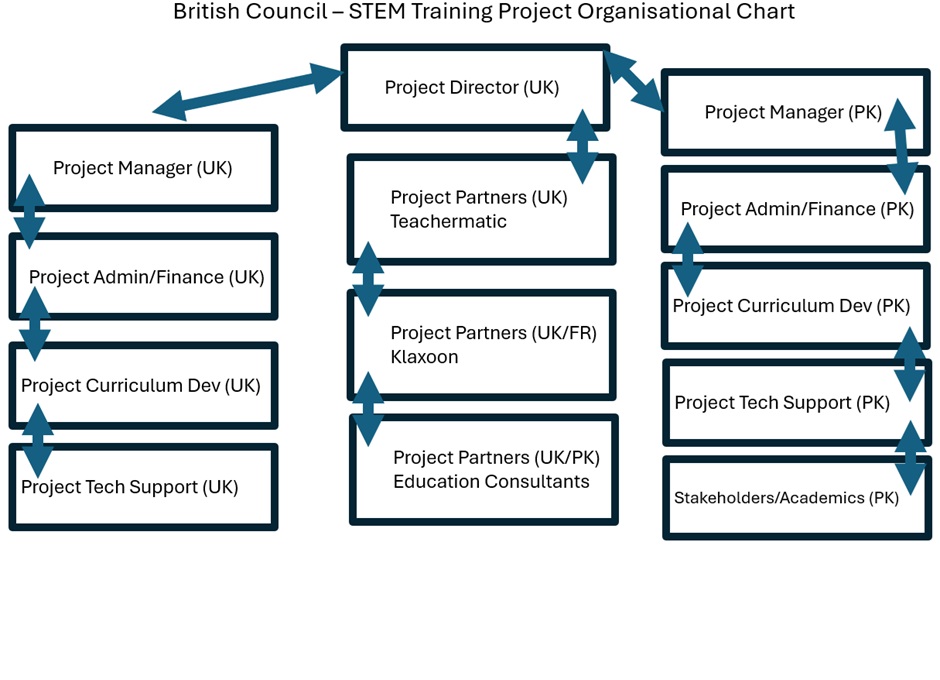
Personnel proposed
Present the names and relevant experience of the key experts who will be engaged in the project delivery. Please add CVs at the end of the form.
Dr Anthony Basiel – Solent University (UG/PG) Module Leader and Project Supervisor
I have been Project Manager for several British Council projects in the past such as; CEDEFOP Study Visit Programme – I was an attendee and managed 2 London UK training events with +12 European delegates for a week-long training which included corporate visits and hands-on computer software labs. I was Project Manager for a British Council training series with the University of Gaza. We were not able to facilitate the project in person, so we researched – designed – delivered and evaluated a series of training workshops to help university academics design online curriculum. Finally, I have also written a book chapter on English Language Teaching and Assessment online for the British Council. I have over 2 decades of experience as a Senior UK University Academic and Manager in roles such as Associate Dean and Head of Academic Operations. As an Adobe International Education Leader I have worked as a Blended Learning Solutions Consultant for a wide range of organisations such as Oxofrd University and the Natural History Museum, London. My Doctorate is in Learning Technology Design. I have beek keynote speaker at many international education conferences. Since 1996, I have written over 60 learning technology publications. I have a good balance of academic, leadership and project management capabilities to be successful in this project.
[ add biography and CV ]
Management plan [ 347 words – no limit ]
Management Plan for British Council Project
The Project Managers communicate on/off-line in regularly scheduled meetings in line with the Gantt chart. Action points are identified with each meeting agenda with progress tracking done each week. Risk analysis identifies the threats with a prevention strategy implemented to stop critical incidents before project failure.
Objective:
To strengthen STEM education in Pakistan by fostering capacity building through UK-Pakistan collaborations, empowering faculty with innovative teaching methodologies, and enabling sustainable knowledge transfer.
Implementation Framework:
- Project Phases:
Phase 1: Needs Analysis and Planning
Conduct stakeholder consultations to identify skill gaps and contextualise training modules for Pakistani faculty. Finalise partner institutions in the UK for training and collaboration.
Phase 2: Faculty Training in the UK
Organise an institutional visit to Solent University for 25 faculty members, exposing them to cutting-edge teaching and assessment practices. Deliver focused training on:
- Effective Teaching and Assessment Practices
- High-Impact Pedagogical Techniques
- Technological Integration in STEM Education
- Microteaching and STEM Practicum at higher education levels
Phase 3: Cascading Model Development
Develop training materials and guidelines for 25 trained UK delegates to cascade knowledge to 75 additional faculty in Pakistan.
- Deliverables:
- Establishment of a professional STEM education network of 100 trained faculty.
- Twinning and collaboration between UK and Pakistani institutions.
- Faculty trained in high-impact pedagogies, research integration, and digital teaching tools.
- Sustainability through cascading training and materials.
- Evaluation and Monitoring:
- Develop clear KPIs to track progress, including the number of faculty trained, knowledge dissemination success, and student outcomes.
- Regular feedback sessions with participants to refine training approaches.
- Post-training follow-ups to ensure application of learned methodologies in classroom practices.
- Technology Integration:
Promote the use of digital tools in professional practice, including virtual collaboration platforms, e-learning resources, artificial intelligence generators, blended learning simulations and assessment software. - Sustainability:
- Foster long-term UK-Pakistan institutional collaborations for ongoing knowledge exchange.
- Create a repository of training materials and digital resources accessible to STEM educators in Pakistan.
This management plan ensures impactful delivery and sustainable improvement of STEM education in Pakistan.
British Congress Presentation: AI for Healthcare Training 11/06/2024
Posted by abasiel in Uncategorized.Tags: AI, artificial-intelligence, education, healthcare, online-learning, technology
add a comment
AI and Big Data Session: 27 June 2024
‘An Artificial Intelligence (AI) Learning Simulation Model to Support Healthcare Professionals’ – Dr Anthony Basiel
This research explores ways to use AI integrated in a learning simulation. The aim is to measure the impact of using AI on the confidence level of healthcare professionals doing continuous professional development (CPD) training.
Learning and development events are recorded and auto-transcribed during a 4-stage process:
Stage 1: Pre-test – First we establish the learner’s prior knowledge. Stakeholders complete a quiz that sets the baseline of the academic and tacit (hands-on) knowledge. The questions are generated from the Tutor and Learners aided by an AI agent.
Stage 2: Simulation – A real-world scenario or role-play simulation based on the training learning objectives is used to test the application of the healthcare professional’s knowledge and skills. An AI generator is used by the Tutor to produce a draft of the script for the Facilitator(s). The learners respond to the prompts of the facilitator(s) to demonstrate their expertise and skills in the context of the problem addressed. The event is recorded.
Stage 3: Debriefing – After the role-play a pair of Simulation Evaluators (SE) moderate a debriefing discussion group. This Socratic circle model produces evidence to validate the healthcare professional’s capability and confidence level. One SE is human asking empathetic prompts. An AI generated digital twin provides generic debriefing questions through a computer webinar interface.
Stage 4: Evaluation – The learning outcomes are mapped to the transcript text with assistance from an AI agent. The simulation debriefing results are matched to the starting quiz marks to determine the level of learning. An online survey is used to get quantitative and qualitative data to measure confidence levels of the professionals.
This interactive presentation will give the audience an opportunity to contribute to an online survey to compose a pre-simulation quiz question with a correct multiple choice solution that is linked to a reference by using an AI agent.
Hello Congress Delegates. I hope this video introduction finds you well.
I am Dr Anthony ‘Skip’ Basiel from the School of Computing Science at Bournemouth University, Dorset – UK. My research explores blended learning solutions to promote creativity and innovation for healthcare professionals. Recently I was a Post-doc Research Fellow at the Faculty of Health and Social Science where I investigated various technologies and learning designs for face-to-face and online learning simulations. My Doctorate in Learning Technology Design has provided a strong pedagogic and technical foundation to research and develop immersive webinar designs using blended Socratic discussion circles with augmented reality.
I’m presenting my keynote entitled, ‘An Artificial Intelligence (AI) Learning Simulation Model to Support Healthcare Professionals’ Continuing Professional Development’ at the IKSAD British Congress.
With over 60 international publications since 1996, I invite you to visit my website at https://abasiel.uk where you can find journal papers, online learning toolkits and interactive web video tutorials to sample. Please do email abasiel@gmail.com if you are interested in collaborating on any research projects.
I look forward to meeting you in London on the 27th June and encourage you to register for this global event at: www.britishcongress.co.uk.
Thanks for your interest.
A 4-stage AI assisted assessment model 21/05/2024
Posted by abasiel in Uncategorized.Tags: assessment, education, learning, online-learning, teaching
1 comment so far
Dr Anthony ‘Skip’ Basiel | abasiel@gmail.com
This Project Proposal aims to use AI to develop an innovative assessment model by blending with learning simulations. Education Institutions in the United Kingdom (UK) use learning assurance procedures to produce evidence of a learner’s academic knowledge, capabilities or skills (Hoecht, A 2006). There are 3 general types of summative assessment. Traditional exams use a criterion-based methodology (Scarpa, R. 2011). This is often an individual written (open or closed book / on-or-offline) essay set to a sequence of questions. An external marking criteria or rubric is applied to the responses to establish a grade ranking of learning outcome (LO) mastery from distinction to merit to pass or fail (Cox, G 2015). This assessment system does not consider the learner’s prior knowledge. The initial assumption is ‘tabula rasa’, or the learner is a blank slate (DLE 2024). Rather than measuring the learners’ assessment evidence against a fixed external set of criteria, a norm-referenced model can be used (Hoko, J). Here the learner’s capabilities are ranked against the others in their assessment group. The highest marks are seen as distinction in relation to a grading curve (Aviles, C. 2001), but still the assessment rubric is an external criterion.
What assessment model can factor-in the learner’s prior and professional experiential, or tacit, knowledge? An ipsative assessment design uses a pre-test comparison to the final evaluation (Hughes, G. 2011). In this way we set learning benchmarks. First, we establish the baseline of the learner’s knowledge and skills. Next, stakeholders progress through the learning event’s curriculum. A summative assessment concludes the sequence. Marking is done by measuring the difference between the pre-test to the endpoint.
These summative assessment models can also use a web 2.0 learner-generated content methodology (Basiel A. & Coyne P.2009). A learner-centred pedagogy uses a bottom-up curriculum/assessment design demonstrated in two interventions:
Self-assessment – Pre-set learning outcomes are mapped to the evidence in the deliverables of the assessment media. For example, in a written exam the LO is linked to the page providing evidence of mastery. In a dynamic role-play (learning simulation) assessment, the link could be in the transcript or video of the skill performed.
Peer-review – A study partner/group provides the learner with peer feedback from the stakeholders’ perspective of the LOs. A read-aloud protocol (Gibson 2008) can be used to hear grammar mistakes or unclear narration.
This project explores how AI can be used in combination with learning simulations as a process supported by the content and/or skills required to be successful (Linser, R. & Ip, A. 2002). Shaharuddin et al. (2012) recognises the importance of underpinning the learning simulation choreography with a social constructivists’ foundation. The stakeholders in the simulated learning event make meaning as they address the issue or solve the problem of the scenario. The learner can be an individual interacting with an avatar or other humans via a webinar platform. The simulation facilitator(s) provide and induction and context to the scenario before the role-play is initiated.
This proposed blended learning model uses a convergence of AI with interactive webinar design. It is a trans-disciplinary approach that aims to promote the development of procedural knowledge, creativity and innovation as well (if needed) as the demonstration of specific skills. For example, if the simulation was to access the SGS counselling courses (2024) a scenario to validate the required counselling practice could be demonstrated through the virtual role-play.
Where does the AI component fit into the framework design? There are 3 stages in our AI Blended Simulation Assessment model:
- Pre-test
- Virtual Simulation
- Debriefing
Stage 1:
A generative AI tool such as Teachermatic (2024) can provide a pre-test multiple choice quiz (MCQ) with correct responses and links to core reading references. The prompt may include the knowledge domain, academic/professional level, course learning outcomes/competencies to acquire, links to government standards (e.g. data protection, GDPR 2024), ethical guidelines (e.g. BERA 2024), etc. The tutor can then review and refine the pre-assessment tool to help establish the learner’s starting knowledge. A variation of this stage can be to get the students to contribute to the MCQ pool of questions, answers and reference sources. This is another example of a learner-generated (Web 2.0) assessment approach.
Stage 2: The production of the learning simulation is linked to the academic partners for this pilot case study. An output of the study will be establishing the appropriate blend of the use of AI, video and human role-play that will be used with each tutor and their subject specific requirements. Using the module learning outcomes as a guide a script can be played out by using the human participants and/or digital twins. An example of how AI and digital twins can be uses is seen through a blended workshop conducted at Bournemouth University (2024) and presented in a conference at the University of London (2024) (Basiel 2024). Recordings of the event provides evidence that can validate the module learning outcomes. Variations of digital simulation environments will be explored. Klaxoon (2024) is a platform we can use who have partnered with us in the past.
Stage 3: Arguably the most important part of the learning situation is debriefing at the end (Fanning 2007). One or two Facilitators (on-or-offline) ask open-ended questions to the key simulation actors (Cheng et al. 2015). The discussion identifies general reflection issues such as what went well, where could you improve and what would you do differently? Subject specific questions linked to the learning outcomes can be added to the debriefing script. One variation to be explored is the use of digital twins as one of the debriefing Facilitators for non-empathetic questions. The virtual debriefing model can use a Socratic discussion circle (Howarth, M.S. and Basiel A. 2022). Key actors sit in a central circle with the observers on the outer circle. Responses start with the inner circle actors with the outer circle learners joining with their perspectives. In person debriefing can use a 360* augmented reality camera to record the event allowing the viewer to click on the video to see around the room from different angles. See an example at https://abasiel.uk/2024/03/15/360-immersive-blended-webinar-ai-turing-test/ .
SMART (specific, measurable, achievable, relevant and time-bound) Project Objectives:
This proposal aims to address the BERA goals to research and develop the innovative use of AI in a Further Education context. The SMART objectives are:
Establish a sound project management strategy to promote communication between the study partner organisations and the stakeholders.
Identify appropriate technologies to support the case study for the AI Blended Simulation Assessment model.
Apply underpinning pedagogic designs to research and develop the case study stages (e.g. pre-test, simulation, debriefing).
Comply with BERA ethics and GDPR policy to collect and analyse data to attempt to validate project conclusions.
Build a virtual learning community to disseminate project findings.
Evaluation
The project designs will be validated by data collected in a pre/post event survey and webinar focus groups. We establish what the stakeholders’ pre-expectations are going into the learning event which are matched against the summative assessment results.
References
Aviles, C. B. (2001). Grading with norm-referenced or criterion-referenced measurements: To curve or not to curve, that is the question. Social Work Education, 20(5), 603–608. https://doi.org/10.1080/02615470120072869
Basiel A. Coyne P. (2010), ‘Exploring a Professional Social Network System to Support Learning in the Workplace Social’ Web Evolution: Integrating Semantic Applications and Web 2.0 Technologies DOI: 10.4018/978-1-60566-272-5.ch001
Basiel, A. (2024) https://abasiel.uk/2024/04/26/u-of-london-ride-conference-24/
BERA (2024) https://www.bera.ac.uk/publication/ethical-guidelines-for-educational-research-2018
Cheng, A, Palaganas, J. Walter, Rudolph, J., Robinson, T., Grant, V. (2015), ‘Co-debriefing for Simulation-based Education, A Primer for Facilitators’, Simulation in Healthcare: The Journal of the Society for Simulation in Healthcare 10(2):p 69-75, April 2015. | DOI: 10.1097/SIH.0000000000000077
Cox, G.; Morrison, J.; Brathwaite, B. (2015). The Rubric: An Assessment Tool to Guide Students and Markers. En 1ST INTERNATIONAL CONFERENCE ON HIGHER EDUCATION ADVANCES (HEAD’ 15). Editorial Universitat Politècnica de València. 26-32. https://doi.org/10.4995/HEAd15.2015.414
Discourses on Learning in Education (DLE 2024) https://learningdiscourses.com/discourse/tabula-rasa/
Fanning, R. M.; Gaba, D. M.(2007), The Role of Debriefing in Simulation-Based Learning The Journal of the Society for Simulation in Healthcare 2(2):p 115-125, Summer 2007. | DOI: 10.1097/SIH.0b013e3180315539
GDPR (2024) https://gdpr-info.eu/
Gibson S. (2008), Reading aloud: a useful learning tool?, ELT Journal, Volume 62, Issue 1, January 2008, Pages 29–36, https://doi.org/10.1093/elt/ccm075
Hoecht, A. Quality Assurance in UK Higher Education: Issues of Trust, Control, Professional Autonomy and Accountability. High Educ 51, 541–563 (2006). https://doi.org/10.1007/s10734-004-2533-2
Hoko, J. Aaron. “Evaluating Instructional Effectiveness: Norm-Referenced and Criterion-Referenced Tests.” Educational Technology, vol. 26, no. 10, 1986, pp. 44–47. JSTOR, http://www.jstor.org/stable/44424737. Accessed 28 Apr. 2024.
Howarth, M.S., Basiel, A. (2022). Production of the 70:20:10 Webinar. In: MacCallum, K., Parsons, D. (eds) Industry Practices, Processes and Techniques Adopted in Education. Springer, Singapore. https://doi.org/10.1007/978-981-19-3517-6_13
Hughes, G. (2011) ‘Towards a personal best: a case for introducing ipsative assessment in higher education’, Studies in Higher Education, 36(3), pp. 353–367. doi: 10.1080/03075079.2010.486859.
Klaxoon (2024) – https://klaxoon.com
Linser, R. & Ip, A. (2002). Beyond the Current E-Learning paradigm: Applications of Role Play Simulations (RPS) – case studies. In M. Driscoll & T. Reeves (Eds.), Proceedings of E-Learn 2002–World Conference on E-Learning in Corporate, Government, Healthcare, and Higher Education (pp. 606-611). Montreal, Canada: Association for the Advancement of Computing in Education (AACE). Retrieved April 29, 2024 from https://www.learntechlib.org/primary/p/15277/.
Scarpa, Raymond DNP, AOCN; Connelly, Patricia E. PhD, CCC-A, ABA. Innovations in Performance Assessment: A Criterion Based Performance Assessment for Advanced Practice Nurses Using a Synergistic Theoretical Nursing Framework. Nursing Administration Quarterly 35(2):p 164-173, April 2011. | DOI: 10.1097/NAQ.0b013e31820fface
SGS (2024) Counselling Courses https://www.sgscol.ac.uk/study/counselling
Shaharuddin Md. Salleh, Zaidatun Tasir, Nurbiha A. Shukor (2012), Web-Based Simulation Learning Framework to Enhance Students’ Critical Thinking Skills,
Procedia – Social and Behavioral Sciences, Volume 64, 2012, Pages 372-381,ISSN 1877-0428,https://doi.org/10.1016/j.sbspro.2012.11.044.
(https://www.sciencedirect.com/science/article/pii/S1877042812050215)
Teachermatic (2024) https://teachermatic.com/
 Dr Anthony 'Skip' Basiel - Blended Learning Solutions